Slate Team

Key Takeaways
Social media Stories on Instagram, Facebook, and TikTok-style vertical formats are now one of the fastest ways for brands to deliver short, emotional narratives that drive action and create meaningful connections with audiences.
Effective Stories incorporate key elements of storytelling, such as authenticity, emotional appeal, and audience understanding, to engage viewers and strengthen brand identity.
A clear message is essential for effective storytelling in Stories, ensuring that the narrative is concise, focused, and easily understood by the audience.
The best advertising stories are clear and concise, making it easy for the audience to grasp the intended message quickly.
Narrative structure—hook, tension, payoff—matters just as much in a 15-second Story frame as in a long-form video ad or traditional advertising spot.
Brands using story-based sequences in Stories consistently see higher completion rates, swipe-ups, and saves compared to single-frame promotional social media posts.
Slate helps teams build consistent, on-brand Stories quickly across channels while still allowing creative flexibility for authentic stories.
This article provides specific examples, recommended structures, and a practical workflow to plan and produce Stories efficiently—turning your storytelling efforts into measurable results.
What Are Stories on Social Media and Why They Matter in 2026
It started with a simple idea: what if social content could disappear? In October 2013, Snapchat introduced ephemeral 10-15 second clips that vanished after 24 hours, designed to capture spontaneous, authentic glimpses into users’ lives rather than polished curation. By 2016, Instagram had adopted the format, and the floodgates opened. Today, nearly every major platform—Facebook, LinkedIn, Pinterest, YouTube, and TikTok—has embraced some version of Stories, transforming them into a core mechanism for bypassing algorithmic feeds and securing prime visibility.
Stories are vertical, full-screen, time-limited content pieces—typically 15 to 60 seconds per frame—designed for quick, serial consumption with sound on. Unlike static feed posts, they occupy the top of your followers’ screens, demanding immediate attention. With over 5.42 billion social media users globally in 2025, Stories represent one of the most direct paths to your target audience.
The difference between Stories, Reels, and feed posts matters less than you might think. All three are storytelling canvases. But Stories excel at ephemeral, in-the-moment narratives that create a genuine connection through their raw, unpolished feel.
Why Stories are central to modern social strategies:
They bypass restrictive algorithms to ensure visibility at the top of feeds
They drive engagement through interactive elements like polls, questions, and stickers
They support serial storytelling across multiple frames or days
They encourage authentic, behind-the-scenes content that builds trust
They work across platforms, from Instagram’s 2 billion users to LinkedIn’s 1.33 billion professionals
Storytelling Fundamentals Applied to Social Media Stories
Classic storytelling elements—character, conflict, transformation—don’t disappear when you’re working with short videos. They compress. The hero’s journey is a classic structure often used to create compelling narratives, even in short-form content. The hero’s journey that might unfold over two hours in a film must happen in 3 to 10 frames or 30 to 60 seconds.
The key is understanding that every great story follows a predictable emotional arc, and your audience effectively expects that structure even when they don’t consciously recognize it. Good storytelling relies on key elements such as emotional connection, authenticity, and a clear narrative structure. A compelling story in Stories format needs the same ingredients as any effective brand story: a main character (often your customer or your brand), a problem worth solving, and a transformation that inspires action.
The ideal micro-story arc for Stories:
Frame | Purpose | Example |
|---|---|---|
Frame 1 | Hook - grab attention in first 1-2 seconds | Athlete’s alarm going off at 5:30am |
Frames 2-3 | Tension/problem - establish stakes | Training montage, self doubt before big game |
Frames 4-5 | Solution/brand moment - show transformation | Product in action, confidence restored |
Final Frame | CTA - inspire action | “Shop the gear that powers champions” |
A classic story arc includes introducing characters and setting, presenting a conflict, and concluding with a resolution tied to the key message.
Consider a sports brand telling a good story through Stories: Frame one shows an athlete’s phone alarm blaring in darkness. Frame two captures the struggle of early morning training. Frame three reveals the tension of pre-game nerves. Frame four shows game-time confidence. The final frame delivers the brand’s message with a clear call to action.
Emotional triggers—anticipation, relief, aspiration, belonging—can be deliberately mapped to specific frames. Your video script for a 6-frame Story should identify which emotion you want to evoke at each moment. This strategic use of narrative structure is what separates forgettable content from stories that create connections on an emotional level.
Understanding the Audience for Social Media Stories
To craft a compelling story on social media, everything starts with a deep understanding of your target audience. Effective storytelling marketing isn’t just about what you want to say—it’s about what your audience needs to hear, see, and feel. By analyzing demographics, interests, and behaviors, brands can develop a brand story that truly resonates, ensuring every narrative is tailored to the people who matter most.
When you know your audience, you can create stories that speak directly to their desires, challenges, and aspirations. This insight allows you to build emotional connections that go beyond surface-level engagement, fostering brand loyalty and encouraging your audience to take action. Whether you’re sharing behind-the-scenes moments, customer testimonials, or interactive polls, your storytelling efforts become far more effective when they’re rooted in real audience understanding.
Great storytelling on social media is about more than just broadcasting a message—it’s about creating a two-way relationship. By listening to your audience and reflecting their world in your stories, you transform your brand from just another voice online into a trusted companion. This is the power of storytelling: it turns marketing into a conversation, and your brand into a memorable part of your audience’s daily life.
Types of Social Media Stories Brands Should Use
Not every story type works for every brand. The most successful storytelling marketing matches format to audience and objective. Here are the story types that consistently drive most engagement:
Day-in-the-Life Stories Works for: DTC brands, personal brands, service businesses Frame outline: Morning routine → work/creation process → customer interaction → end-of-day reflection This format humanizes your brand shares and shows the human touch behind products or services.
Before vs. After Transformation Stories Works for: Fitness, beauty, home improvement, SaaS platforms Frame outline: Problem state → process hint → reveal → results metrics Real customers sharing their own experiences create the most compelling narratives for this format.
Countdown to Launch Series Works for: Product launches, events, campaigns across all industries Frame outline: Day 5 teaser → Day 3 behind-the-scenes → Day 1 final prep → Launch moment This multi-day serial storytelling builds anticipation and keeps your brand at the top of feeds.
Customer Transformation Stories Works for: B2B, fitness, education, coaching Frame outline: Customer’s original challenge → solution discovery → implementation journey → outcome celebration These real stories from real customers serve as powerful social proof.
Behind-the-Scenes Stories Works for: Manufacturing, creative agencies, restaurants, sports teams Frame outline: Raw footage of process → team members at work → unexpected moments → finished product Almost entirely visual—quick cuts with on-screen text—perfect for sound-off viewing.
Live Event Recap Stories Works for: Sports, conferences, concerts, festivals Frame outline: Arrival/atmosphere → key moments → crowd reactions → highlights reel Works especially well for time-sensitive content during 2024-2025 events.
Product How-To Stories Works for: Tech, beauty, home goods, food brands Frame outline: Problem setup → product introduction → step-by-step use → final result Educational content that positions your brand as helpful rather than purely promotional.
Authenticity, Trust, and Visual Consistency in Stories
Here’s what changed between 2020 and 2025: audiences developed a sixth sense for inauthenticity. A polished TV edit repurposed for Instagram Stories often performs worse than raw iPhone clips. The world of social media rewards authenticity over production value.
Audiences don’t want to watch advertisements. They want to feel like they’re getting an inside look at something real.
Authentic storytelling builds trust, as consumers can easily detect inauthentic narratives.
But “authentic” doesn’t mean “messy.” The most effective storytelling balances raw, human content with consistent brand visuals—colors, fonts, logo usage, and transitions that tie diverse footage together without making it feel corporate.
Authentic but messy:
Shaky footage with no visual consistency
Random fonts and colors each day
No recognizable brand elements
Feels disjointed across posts
Polished but cold:
Over-produced, clearly staged moments
Stock music and generic templates
Lacks personal experience or real voices
Feels like traditional advertising
The winning combination:
Real footage from real moments
Consistent lower-thirds and color filters
On-brand templates that frame authentic content
Team members and real customers as main characters
Imagine a nonprofit sharing volunteer Stories from a 2025 field mission. The footage is raw—captured on smartphones in challenging conditions. But consistent lower-thirds identify each volunteer, a subtle color filter ties clips from different locations together, and the brand’s core message appears in the final frame. The result feels both genuine and professional. It’s crucial that every story clearly communicates the brand's message, ensuring audiences connect with the brand’s values and unique selling points.
This is where Slate becomes essential. Pre-built, on-brand templates mean any team member can capture authentic clips while maintaining brand integrity. The compelling narratives emerge from real moments, not from endless design iterations.
The Importance of a Clear Core Message in Stories
At the heart of every effective brand story is a clear core message. This message acts as the guiding light for all your storytelling efforts, ensuring that every story you share aligns with your brand’s values, mission, and unique selling proposition. Without a defined core message, even the most creative narratives can feel scattered or forgettable.
A strong core message helps your brand stand out in a crowded social media landscape. It differentiates you from competitors and ensures that your audience walks away with a lasting impression of who you are and what you stand for. Before you start creating Stories, take the time to define what you want your audience to remember—this clarity will shape every frame, caption, and call to action.
When your core message is woven seamlessly into your Stories, you create meaningful connections with your target audience. Each narrative becomes an opportunity to reinforce your brand’s identity and inspire brand loyalty. Ultimately, a clear core message is the foundation of storytelling marketing that not only grabs attention but also builds trust and drives results.
Examples of Strong Storytelling on Social Media Stories
Effective brand story examples show how narrative structure translates to real results. Here are illustrative campaigns that demonstrate great storytelling in action:
Fitness Brand “5AM Club” Series (Instagram Stories) A gym chain followed members through their early morning routines for a week-long series. Each day featured a different member’s own story—their motivation, struggles with self doubt, and small victories. The series generated 3x typical reply rates and significantly increased class bookings during the campaign period.
SaaS Platform “First 30 Days” Journey (LinkedIn Stories) A B2B software company documented a client’s implementation journey through daily Story updates. Frames showed real challenges, team problem-solving, and milestone celebrations. This storytelling remains one of their highest-performing lead generation assets, proving B2B brands can thrive with Stories when they focus on customer transformation.
Fashion Brand Black Friday 2025 Countdown (TikTok + Instagram) Five days of behind-the-scenes Stories showing warehouse preparation, product reveals, and team excitement built anticipation for the sale. The brand shares created such strong engagement that their email list grew 40% in the week before launch.
Sports Team 2024 Olympics Coverage (Instagram Stories + YouTube Shorts) Real-time Stories from athletes, coaches, and fans created an immersive experience during competition. The brand used consistent templates—updated in minutes through centralized tools—to push Stories in multiple languages while keeping visuals consistent. This great example showed how live events demand both speed and brand consistency.
Museum “After Hours” Series (Instagram Stories) A natural history museum created a weekly “what happens when visitors leave” Story series. Night security guards shared their personal experience walking empty halls, revealing behind-the-scenes details visitors never see. The series drove a 25% increase in evening event attendance.
Food Brand “Recipe Challenge” Interactive Series (Instagram Stories) Using poll stickers and question boxes, a food brand let followers vote on ingredients for a recipe their chef would create live. The interactive narratives generated thousands of direct messages and created a deeper level of connection than standard promotional content.
Additional notable campaigns that showcase powerful storytelling in social media include:
Nike's 'Winning Isn't Comfortable': Focuses on the struggle and discomfort athletes face, rather than just their victories, highlighting perseverance.
Guinness 'Made of more': Tells the true story of the Japanese women's rugby team Liberty Fields RFC, celebrating resilience and teamwork.
Eva Stories: Chronicles the last days of a real 13-year-old Hungarian Jew in 1944 through Instagram Stories, bringing history to life for a new generation.
Mailchimp's Bloom Season: A docuseries spotlighting Black entrepreneurs and their experiences during the pandemic, emphasizing community and resilience.
Barclaycard's Two Films: Created two films from different perspectives to show how a couple accommodates each other's passions, illustrating empathy and understanding.
Adidas 'You Got This': Focuses on self-doubt and the support athletes receive from coaches and teammates, promoting encouragement and mental health.
Square's Community Films: Produced a series of films chronicling how communities uplift themselves despite tough circumstances, highlighting collective strength.
Norwich City FC's Suicide Prevention Campaign: Uses storytelling to highlight the importance of recognizing and addressing struggles, raising mental health awareness.
Fairmont Queen Elizabeth Hotel's Immersive Experience: Celebrated John Lennon and Yoko Ono's historic bed-in for peace with an immersive storytelling event.
Visit Oslo's 'Is it even a city?': Uses brutal honesty to create a memorable and authentic narrative about the city, standing out with its unique approach.
Vodafone's Dance Campaign: Features a choreographed dance to illustrate the 'unlimited' aspects of its new data plans, using movement as a storytelling device.
Dove's 'Real Beauty' Campaign: Leveraged video ads to convey authentic messaging and engage audiences, sparking global conversations and increasing revenue.
How to Plan a Stories-First Social Strategy
Random posting is the enemy of effective storytelling. Your marketing strategy should treat Stories as narrative sequences on a content calendar, not disconnected one-off posts.
A story told consistently across a week creates more brand loyalty than a dozen random posts scattered over a month.
Stories work best when planned around “story pillars”—thematic categories that ensure variety while supporting your company’s mission and brand values. Story pillars should align with the company's mission to ensure authenticity and consistency. Your story should also promote a Unique Selling Point (USP), something that differentiates the brand from its competitors.
Sample Story Pillars:
Education: How-tos, tips, industry insights
Entertainment: Behind-the-scenes, team moments, humor
Proof: Customer testimonials, results, user generated content
Behind-the-Scenes: Process reveals, day-in-the-life, making-of content
Example 7-Day Stories Calendar:
Day | Pillar | Story Type | Frames |
|---|---|---|---|
Monday | Behind-the-Scenes | Founder morning routine | 4-5 |
Tuesday | Education | Quick product tip | 3-4 |
Wednesday | Proof | Customer spotlight | 5-6 |
Thursday | Entertainment | Team moment/office life | 3-4 |
Friday | Behind-the-Scenes | Week recap + weekend plans | 4-5 |
Saturday | Entertainment | Casual Q&A or poll | 2-3 |
Sunday | Proof | Community highlight | 3-4 |
Build reusable Story templates—intro frame, quote frame, poll frame, CTA frame—so teams can craft stories quickly while staying on-brand. With Slate, these templates live in a central system, allowing anyone on your team to create Stories that maintain visual consistency without starting from scratch.
Creating an Own Story that Stands Out on Social Media
In a world where everyone is vying for attention, creating your own story that stands out on social media is essential. Embracing storytelling means going beyond generic content and crafting a brand story that is uniquely yours—one that leverages interactive elements, short videos, and Instagram Stories to engage your audience on a deeper level.
A great story is memorable because it feels real. Use user generated content, behind-the-scenes glimpses, and authentic moments to highlight the human touch behind your brand. Interactive elements like polls, questions, and challenges invite your audience to participate, turning passive viewers into active community members. This approach not only drives engagement but also creates a genuine connection that inspires action.
Storytelling in marketing is about more than just selling a product—it’s about sharing real stories that evoke emotion and reflect your brand’s values. By focusing on what makes your brand different and showcasing the people and experiences behind it, you create a lasting impression that sets you apart. The ultimate goal is to use the power of storytelling to turn followers into loyal advocates, making your brand a memorable part of their social media world.
Creating Stories Efficiently Across Teams with Slate
When marketing, social, and creative teams work in silos, Stories suffer. One team posts something off-brand. Another waits days for approvals. A third recreates assets that already exist somewhere in a shared drive.
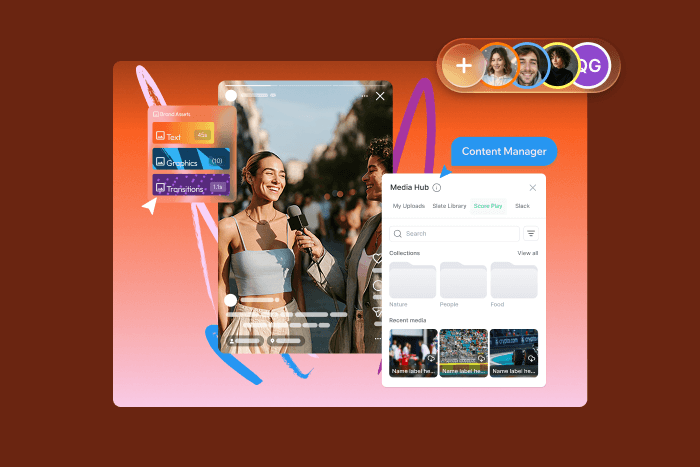
Slate solves this by serving as a central hub where all teams collaborate on Story assets for Instagram, TikTok, Facebook, and YouTube.
The Slate Workflow for Stories:
Brand uploads core assets - Fonts, colors, logos, and brand guidelines live in one place
Designers build Story templates - Intro frames, transition styles, CTA formats are pre-approved
Social managers and creators fill templates - New clips drop into proven structures daily
Approvals happen in real-time - No more email chains or lost feedback
Assets publish across platforms - One source of truth for all channels
Key benefits:
No more off-brand Stories from team members who mean well but lack design training
Faster turnaround during live events when speed matters most
Easier approval processes that don’t bottleneck content
Consistent brand narrative across every platform and region
Consider a global sports brand covering a 2025 tournament. Games happen across time zones. Social teams in different countries need to push real-time Stories within minutes of key moments. Using Slate, they access the same templates, the same brand elements, and the same approved styles—pushing Stories in multiple languages while keeping visuals consistent. The lasting impression on fans is a unified brand presence, not a fragmented mess.
Best Practices for Crafting High-Performing Stories
These practical tips separate Stories that get skipped from Stories that drive engagement:
Front-load your hook - You have 1-2 seconds before someone taps forward. Start with movement, a question, or an unexpected visual. Don’t waste Frame 1 on a logo.
Design for vertical 9:16 - Every element should be optimized for full-screen mobile viewing. Test how text and visuals appear on actual devices.
Add captions for sound-off viewing - Approximately 85% of social video is watched without sound. On-screen text isn’t optional—it’s essential.
Use interactive elements strategically - Polls, questions, and quizzes increase dwell time and provide audience insights. But don’t overuse them—one interactive sticker per sequence is often enough.
Keep copy short and punchy - One idea per frame. One story per sequence. If you need a paragraph, you need another frame.
Emphasize key words visually - Use color, size, or motion to highlight the most important words in each frame.
A/B test your sequences - Try different openings, different CTAs, different frame counts. Track completion rate, replies, profile taps, and link clicks to find what resonates.
Repurpose high performers - Your best Stories deserve a longer life. Save them to Highlights. Re-cut them as Reels. Compile them into TikTok playlists.
Maintain visual consistency - Templates ensure every Story feels like part of the same brand narrative, even when different team members create them.
End with a clear CTA - Tell viewers exactly what to do next: swipe up, tap link in bio, reply with their answer, share their own story.
Measuring the Impact of Your Stories
You can’t improve what you don’t measure. Stories offer rich data that reveals exactly how your audience responds to your narratives.
Key metrics to track:
Metric | What It Measures | Target Indicator |
|---|---|---|
Impressions | Total views | Reach and visibility |
Unique viewers | Individual accounts reached | Audience growth |
Completion rate | % who watched all frames | Content quality |
Forward taps | Taps to next frame | Pacing (high = engaging) |
Backward taps | Taps to previous frame | Interest in content |
Exits | Left Story mid-sequence | Weak points |
Link clicks | Swipe-ups or link taps | Conversion intent |
Sticker taps | Poll/question engagement | Interaction depth |
Replies/DMs | Direct messages generated | Emotional connection |
How to interpret your data:
High forward taps + low exits = Your pacing is right. Viewers want to see what’s next.
High exits on Frame 2 = Your hook isn’t working. Test a different opening.
High backward taps = Viewers want to re-watch something. That frame is valuable content.
High replies = Strong emotional connection. Double down on that storytelling approach.
Set concrete, time-bound goals for your marketing stories: “Increase Story completion rate by 20% over Q3 2025” or “Generate 50 DM replies per week from Story sequences.”
When you use consistent templates through Slate, you isolate narrative variables. Instead of wondering whether a new font or color caused a change in metrics, you can test story angles, hooks, and CTAs directly. This makes optimization faster and more reliable.
Future Trends: Where Social Media Stories Are Heading
The Stories format continues to evolve, and brands that prepare now will capture outsized value in 2026 and beyond.
Emerging trends to watch:
Shoppable Stories - Direct product tagging and in-Story checkout are becoming standard. Your Stories will increasingly serve as storefronts, not just awareness drivers.
AR filters integrated into narratives - Beyond novelty filters, expect branded AR experiences that let viewers try products or interact with story elements in their own environment.
AI-assisted editing - Tools that auto-cut long videos into story-ready sequences will reduce production time dramatically. Brands will produce more Stories with the same team size.
Interactive branching Stories - Choose-your-path narratives where polls determine what happens next. Especially powerful for launches, events, and fandom communities.
Deeper CRM integration - Stories will connect directly to customer data, enabling personalized narratives based on past behavior and preferences.
Cross-platform Story synchronization - Tools that publish optimized Stories to Instagram, TikTok, YouTube Shorts, and LinkedIn simultaneously, adapting format automatically.
The brands who build flexible systems now—with easily updatable templates and centralized visual systems—will adapt to these changes seamlessly. Slate positions teams to embrace new formats without rebuilding workflows from scratch, keeping your storytelling agile as platforms evolve.
FAQ: Stories and Social Media Storytelling
How many frames should a social media Story sequence have for best results?
The ideal range is 3-8 frames for most campaigns. Use shorter sequences (3-4 frames) for simple announcements, quick tips, or single-message promotions. Reserve longer sequences (6-8 frames) for transformation stories, behind-the-scenes arcs, or multi-step tutorials. The ultimate goal is matching length to narrative complexity. Monitor your completion rate and exit data closely—if viewers consistently drop off at Frame 5, your sweet spot might be 4 frames. Every audience is different, so test and refine over time.
Should we post Stories every day, even if we don’t have a big campaign running?
Consistency matters more than campaign intensity. Maintain a baseline of at least 4-5 Stories per week with lighter formats: quick Q&A sessions, “what we’re working on today” snapshots, fast tips, or simple polls. This keeps your brand at the top of followers’ feeds and maintains the habit of consuming your content. High-impact campaigns then layer on top of this baseline. Think of daily Stories as maintaining presence, while campaign Stories drive action.
How do Stories fit with Reels, TikTok, and feed posts in an overall strategy?
Stories excel at ephemeral, in-the-moment narratives and serial updates—perfect for building connection over time. Reels and TikToks are better for discoverability and have a longer shelf life in algorithmic recommendations. A smart workflow: launch a polished hero narrative as a Reel or TikTok for maximum reach, then use Stories to show the making-of, behind-the-scenes footage, and live audience reactions. Feed posts anchor evergreen content. Together, these formats create a complete narrative ecosystem.
Can B2B brands really benefit from Stories, or are they mainly for B2C?
B2B brands can absolutely thrive on Stories by humanizing complex products and services. The key is focusing on customer journeys, live event coverage, product walkthroughs, and team spotlights. A SaaS company might use Stories to follow a client’s “first 30 days” implementing their platform—showing real challenges, small wins, and the people behind the technology. LinkedIn Stories are specifically designed for professional audiences, making them ideal for B2B narratives that would feel out of place on consumer-focused platforms.
What resources do we need to start creating better Stories right away?
Start with a minimal stack:
A modern smartphone with a good camera
Basic lighting (even a ring light makes a difference)
A simple Stories content calendar (spreadsheet works fine)
3-5 reusable templates in Slate for consistency
Clear brand guidelines covering tone, visuals, and voice
Begin with one recurring weekly Story format—perhaps a Friday behind-the-scenes or Monday motivation post. Master that single format, build a repeatable workflow, then expand. Embracing storytelling doesn’t require a massive production budget. It requires commitment to showing up consistently with content that resonates on a personal level.
Conclusion
In conclusion, storytelling remains a powerful tool in marketing, enabling brands to create meaningful connections with their audience and drive business success. By understanding the target audience, defining a clear core message, and crafting compelling narratives, marketers can leverage the power of storytelling to stand out on social media. Effective storytelling marketing involves strategic use, emotional connection, and a deep understanding of the audience’s needs and desires. As brands focus on creating interactive narratives and embracing storytelling, they can drive engagement, foster brand loyalty, and ultimately, achieve their marketing goals. By incorporating storytelling into their marketing strategy, brands can tell stories that resonate, create a lasting impression, and make their brand story one that is remembered and cherished by their audience.