Slate Team
Building a social media brand that stands out requires more than sporadic posting and hoping for the best. In 2025, the brands winning attention are the ones with clear identities, consistent visuals, and authentic voices that audiences recognize instantly—even in a sea of competing content. Managing your brand online and focusing on increasing brand awareness are essential parts of building a strong social media presence.
This guide walks you through every step of how to build a social media brand that drives recognition, trust, and real business results. Whether you’re starting from scratch or tightening up an existing presence, you’ll find practical frameworks, specific benchmarks, and tools that make consistency achievable at scale.
Answer in 5 Minutes: A Quick-Start Checklist
If you need a fast, practical roadmap to build a social media brand in 2025, this checklist gives you the essentials. You could literally work through these steps in an afternoon to establish your foundation. These steps form the foundation of a strong social media marketing strategy.
1. Define your brand fundamentals (30 minutes)Write down your mission (why you exist), your core values, and 3 adjectives that describe your brand personality. Example: “We exist to help small businesses look professional on social media. Our brand is approachable, sharp, and efficient.”
2. Identify your target audience (20 minutes)Describe your ideal customer in one paragraph: their role, their goals, their daily frustrations, and where they spend time online.
3. Choose 1–2 core platforms by end of this weekFor B2C brands: Instagram + TikTok. For B2B brands: LinkedIn + Instagram. Don’t spread yourself thin across every social media platform—focus beats ubiquity.
4. Secure consistent handles across all platforms (15 minutes)Claim your @username on your primary and secondary platforms today. Check availability on social media networks you might use later. If you manage multiple brand accounts, ensure all handles are consistent for a cohesive online presence.
5. Lock in your visual systemChoose primary and secondary colors (with hex codes), 1–2 fonts, and your logo placement rules. Keep it simple enough to execute consistently.
6. Set up 3–5 content pillarsDefine the recurring themes you’ll post about. Example: Education, Behind-the-Scenes, Customer Stories, Product Tips, Industry News. Plan for engaging content within these pillars that encourages interaction and builds brand trust.
7. Build a simple posting scheduleAim for 3–5 feed posts per week on your core platform, plus 3–7 Stories, Reels, or Shorts. Consistency matters more than volume.
8. Pick 3 basic metrics to trackStart with engagement rate, follower growth, and profile visits. You can add more sophisticated key performance indicators later.
9. Choose one tool to keep branding consistentSlate centralizes your templates, fonts, colors, and brand assets so every team member creates on-brand social media posts without guesswork. Social media management tools can also streamline and amplify your social media marketing strategy by automating repetitive tasks and providing critical data for informed decisions.
10. Schedule your first week of contentBlock 2 hours to batch-create your first week of posts using templates. This proves your system works before you scale.
The rest of this article is your deeper, step-by-step guide to executing each of these elements at a professional level.
What Is a Social Media Brand (and Why It Matters Now)
A social media brand is the recognizable identity—visual elements, voice, and experience—that people associate with you on platforms like Instagram, TikTok, LinkedIn, YouTube, and X. It’s what makes someone scroll back up and think, “Oh, that’s from [your brand]” before they even read the caption.
Branding vs. marketing: What’s the difference?
Branding is who you are and how you show up every day. It’s your logo, your colors, your tone of voice, your brand values, and the feeling people get when they interact with your social media pages.
Marketing is how you promote and sell using that identity. It’s the campaigns, the targeted ads, the product launches—all built on top of your brand foundation.
Without clear branding, your social media marketing efforts feel disjointed. With strong branding, every post reinforces what you stand for.
Think of branding as your personality; marketing is what you say and do with that personality to achieve business goals.
Clear marketing messaging that aligns with your brand identity is essential for guiding your social media strategy and engaging your target audience.
The data backs this up. According to industry research, nearly 70% of consumers say a brand’s social media presence directly affects their trust. Brands with consistent identity across social channels see up to 2x higher brand recognition compared to those with fragmented visuals and messaging. Brand consistency increases revenue by 10-20%. Meanwhile, social platforms have become primary discovery engines—most consumers now encounter new brands through social media before any other channel.
What strong social media brands look like:
Duolingo on TikTok turned a language-learning app into a cultural moment. Their chaotic, meme-driven content—featuring their giant green owl mascot—is instantly recognizable and perfectly aligned with their playful brand personality.
Nike on Instagram maintains visual consistency through bold imagery, athlete stories, and a motivational tone that reinforces their “Just Do It” ethos across every single post. Using a signature color can increase brand recognition by 80%.
Trust and authenticity are also critical—88% of consumers say authenticity is a key factor when deciding what brands they support. Building your brand's credibility through strategies like partnering with influencers, leveraging user-generated content, and encouraging social sharing can further establish trust and authentic engagement.
Why this matters for your business:
Higher brand recognition means people remember you when they’re ready to buy
Trust builds faster when your social media presence feels cohesive and professional
Perceived quality increases—consistent brands are seen as more established and reliable
Lower cost per acquisition over time as organic reach compounds and word-of-mouth grows
Building your brand's credibility through consistent and authentic engagement increases trust and authority
Clarify Your Brand Identity Before You Post
Brand identity must be defined before you scale content creation. Otherwise, your feeds become chaotic and forgettable—a collection of random posts with no connecting thread. Clarifying your identity first ensures every piece of content reinforces who you are.
The 4 core elements to define:
Mission: Why does your brand exist beyond making money? What change are you trying to create?
Audience: Who specifically do you serve? What are their goals, frustrations, and aspirations?
Promise: What do you consistently deliver that people can count on?
Personality: How do you sound and behave? What’s your brand persona?
Brand personality types for social media:
Expert mentor: Authoritative, educational, trustworthy. Example: Harvard Business School on LinkedIn—sophisticated thought leadership that positions them as definitive voices in business education.
Playful friend: Fun, approachable, casual. Example: Mailchimp—quirky illustrations and conversational copy that makes email marketing feel less intimidating.
Bold challenger: Provocative, confident, disruptive. Example: Liquid Death—extreme branding for canned water that deliberately subverts category conventions.
A simple framework for 2025:
Pick 3 adjectives that describe your brand (e.g., “smart, warm, direct”) and write a 2–3 sentence brand statement using those words:
“We’re the smart choice for busy marketing teams who need beautiful social content without the hassle. Our tools are warm and intuitive—designed for real people, not design experts. We communicate directly, cutting through jargon to help you post with confidence.”
Sample brand identity: GlowPath Skincare (fictional DTC brand)
Element | GlowPath Definition |
|---|---|
Mission | To make science-backed skincare accessible and understandable for everyone |
Audience | Women 25–40 who want effective products without confusing ingredient lists |
Promise | Clear explanations, clean formulas, visible results in 30 days |
Personality | Friendly expert—approachable but credible, never preachy |
3 Adjectives | Clear, confident, caring |
Brand Statement | “GlowPath makes skincare simple. We translate complex science into clear routines that actually work—because you deserve results, not confusion.” |
This identity becomes the foundation for your branding guidelines and should be stored in a single place where your entire company can access it.
Understand and Prioritize Your Target Audience
Strong social media brands are built for a specific person, not “everyone.” The more precisely you define who you’re talking to, the more effectively your content resonates.
Building audience personas with real data:
Use these sources from 2022–2025 to construct 1–3 simple personas:
Platform analytics: Instagram Insights, TikTok Analytics, and LinkedIn analytics reveal audience demographics, active hours, and content preferences
Website analytics: GA4 shows which social channels drive traffic and what those visitors do on your site
Customer interviews: Direct conversations uncover motivations and language that analytics miss
Reviews and support tickets: Real customer words reveal pain points and desires
What each persona should include:
Demographics: Age, location, job title, income level
Goals: What they’re trying to achieve personally or professionally
Challenges: What frustrates them or blocks their progress
Preferred content formats: Do they watch long videos or prefer quick carousels?
Platforms they use daily: Where do they actually spend time?
Sample persona:
Jordan, 28
Social media manager at a growing e-commerce brand in the US. Manages Instagram and TikTok for a team of 12. Spends 3+ hours daily on social platforms—both for work and personal scrolling. Biggest frustration: creating enough on-brand content without constant designer support. Values quick, practical tips and tools that save time. Prefers short form video content and carousel posts she can screenshot for reference.
How personas shape your content:
Tone of voice: Jordan wants efficiency, not fluff—so your brand voice should be direct and actionable
Posting times: She’s most active during lunch breaks and evening hours
Content length: Quick tips beat long-form essays for her attention span
Platform selection: She’s on Instagram and TikTok daily, LinkedIn weekly
Choose the Right Platforms and Secure Your Brand Presence
In 2025, focus beats ubiquity. Most small and mid-size brands should start with 1–3 primary social platforms where their audience actually spends time, rather than spreading resources thin across every network. A single social media platform done well outperforms five platforms done poorly.
Platform recommendations by business type:
Business Type | Primary Platforms | Secondary Considerations |
|---|---|---|
B2C / E-commerce | Instagram, TikTok, YouTube | Pinterest for visual products |
B2B / Professional Services | LinkedIn, YouTube, X | Instagram for culture/recruiting |
Local Service Businesses | Instagram, Facebook | Google Business Profile |
Personal brand | LinkedIn + one visual platform | Choose based on content style |
Before committing, check audience demographics and behavior data from 2023–2025 platform reports. In 2024, Millennials represented nearly 69% of active social media users, with Gen Z driving short form video content consumption on TikTok and Reels.
Setup checklist for each platform:
Claim consistent @handles across all social media accounts—check availability and secure your brand name before competitors do. If you manage multiple brand accounts, ensure each one reflects your business’s identity and messaging for a cohesive and professional online presence.
Align profile photos using the same logo or headshot everywhere for instant recognition
Update cover images with branded banners that use your primary and secondary colors
Write bios that state who you help and how—not clever wordplay that confuses visitors
Link to a key landing page or Link-in-bio hub that drives action
Using the same logo, colors, and basic templates across networks creates visual cohesion that builds trust and helps increase brand recognition. Slate can centralize and lock these brand assets so every team member uses identical visuals—no more hunting through Dropbox folders or using outdated logos.
Action step: Complete your username and URL audit in one sitting. Block 90 minutes this week to claim handles across key platforms, set up profiles, and ensure visual consistency. Waiting risks losing your preferred name to someone else.
Design a Consistent Visual Identity for Social
Visual consistency is what makes people recognize your posts while scrolling at speed. When your brand identity is clear in every image, graphic, and video thumbnail, you build recognition that compounds over time.
Visual elements to define for social:
Logo usage rules: Where to place it (corners preferred), minimum size, clear space requirements
Primary and secondary colors: 2–3 main colors with hex codes (e.g., #1A73E8) that appear consistently
Typography: 1–2 typefaces—one for headlines, one for body text
Photo style: Bright and candid vs. moody and editorial; lifestyle vs. product-focused
Graphics style: Icon sets, gradient preferences, frames, and overlay treatments
Visual do’s and don’ts:
✅ Do keep your logo small and positioned in corners—let the content be the hero
❌ Don’t place logos over busy backgrounds where they become illegible
✅ Do use brand colors on text overlays for Stories and Reels
❌ Don’t use random trending fonts that clash with your visual identity
✅ Do maintain consistent filters or color grading across photos
❌ Don’t mix vastly different editing styles in the same feed
Creating reusable post templates:
Develop 3–5 templates that cover your core content types:
Quote card: For sharing insights, customer testimonials, or brand values
Product feature: Clean product shots with consistent framing and text placement
Testimonial: Customer quotes with photo and branded frame
Before-and-after: Results-focused content with consistent layout
Announcement: New launches, events, or company news
Templates speed up content creation dramatically. Instead of designing from scratch, your team customizes existing layouts while maintaining brand consistency.
How Slate supports visual consistency:
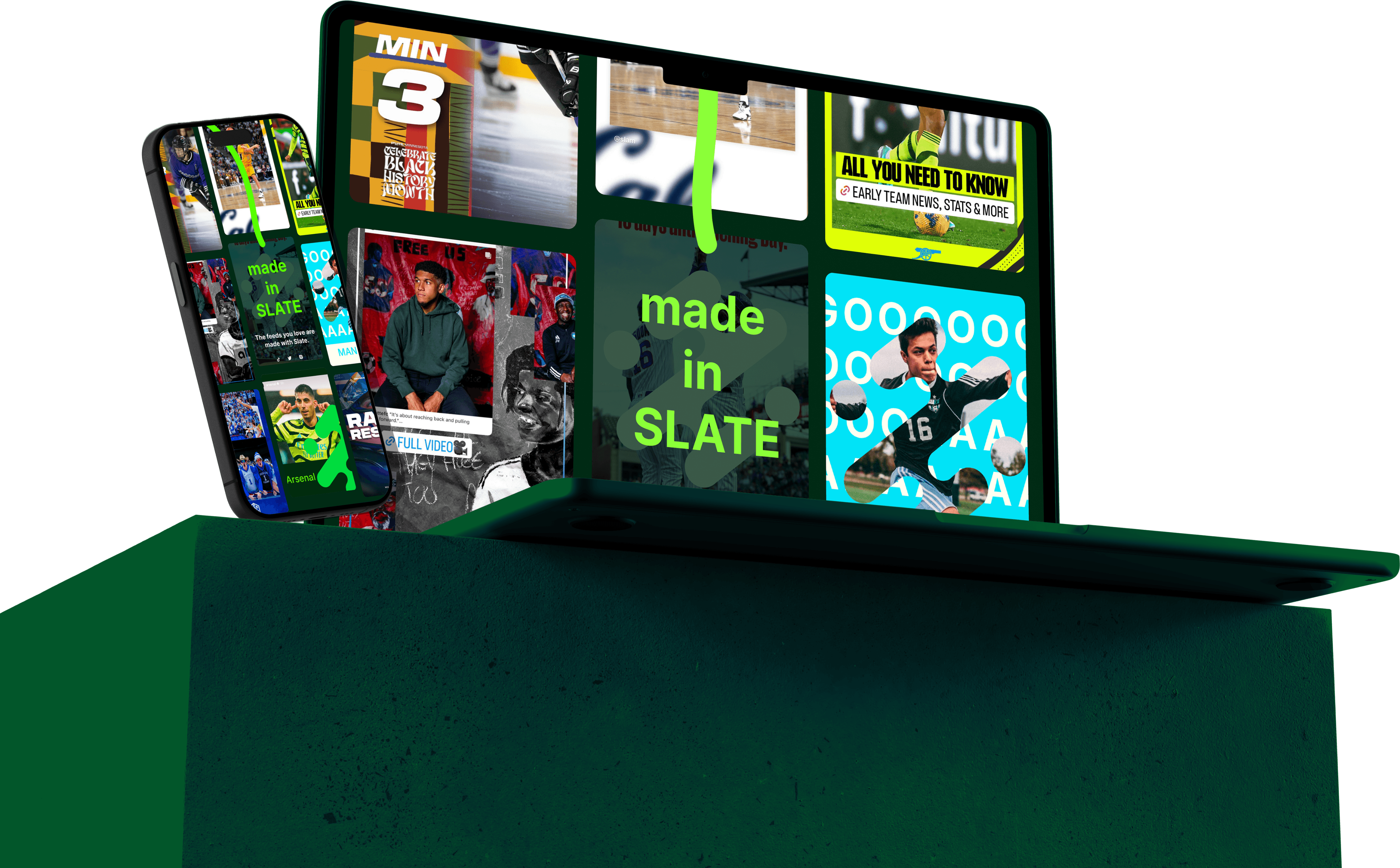
Slate lets teams store fonts, colors, logos, and templates in one brand-safe workspace. Designers upload approved assets, and social media managers can produce on-brand Stories, Reels covers, and feed posts in seconds—even from mobile. There’s no risk of someone using an old logo or off-brand colors because everything is locked and centralized.
Consider a regional sports team posting 100+ times per month during their 2025 season. With Slate, game graphics, player highlights, and promotional content all maintain visual uniformity regardless of which staff member creates them. The result: instant brand recognition that fans associate with professionalism and pride.
Craft a Distinctive Brand Voice and Messaging
Voice is how your brand “sounds” in captions, comments, DMs, and video scripts. A clear, consistent brand voice makes social media content instantly recognizable—even before someone sees your logo. It’s essential to align your marketing messaging with your brand identity and audience preferences to ensure your communication resonates and builds trust.
A simple voice framework:
Pick 3–5 traits that define how your brand communicates, then document what each means in practice:
Trait | What It Means | Words/Phrases to Use | Words/Phrases to Avoid |
|---|---|---|---|
Curious | We ask questions and explore ideas | “What if…?”, “We’ve been wondering…” | Declarative statements only |
Supportive | We encourage without being preachy | “You’ve got this”, “Here’s what works…” | “You should…”, “You must…” |
Punchy | We get to the point quickly | Short sentences, active verbs | Jargon, filler phrases |
Examples of distinctive brand voices:
Duolingo: Playful chaos. Their TikTok captions are unhinged and meme-forward, matching their mascot’s chaotic energy. This wouldn’t work for a bank—but it’s perfect for making language learning feel fun.
Wendy’s: Witty and sharp. Famous for roasting competitors (and sometimes customers) on X. Their brand personality is confident to the point of cocky.
HubSpot: Expert educator. Helpful, thorough, and authoritative without being condescending. They sound like the smart colleague who always has a good answer.
Apple: Warm minimalism. Simple language, short sentences, emotional resonance. They sell feelings, not features.
Caption rewrite exercise:
Generic caption: “Check out our new product! It’s really great and we think you’ll love it. Link in bio.”
Rewritten in expert mentor voice: “After 6 months of testing, our new formula is here. Here’s what makes it different—and why it matters for your routine. Details in bio.”
Rewritten in playful friend voice: “She’s here. 👀 Our new drop just landed and honestly? We’re obsessed. Go see what the hype’s about (link in bio, obviously).”
Rewritten in bold challenger voice: “Everyone else is doing it wrong. We fixed it. New product. Link in bio. You’re welcome.”
Voice in difficult moments:
Your voice guidelines should also cover how the brand handles controversy, mistakes, and customer complaints. Document:
How to respond to negative comments publicly
When to move conversations to DMs
What language to use when apologizing
How to handle trolls (usually: don’t engage)
Store voice rules in the same central brand playbook as your visual guidelines. When agencies or new team members create social media content, they’ll have everything they need to remain consistent.
Build a Content Strategy and Pillars That Fit Your Brand
Random posting doesn’t build a brand. You need content pillars—recurring themes that reinforce what you want to be known for and give your audience clear expectations about what they’ll get from following you.
What are content pillars?
Content pillars are 3–5 categories that all your social posts fall into. They create structure without limiting creativity, ensuring your primary focus stays consistent even as individual posts vary. It’s essential to focus on creating engaging content within each pillar—content that encourages interaction, educates, entertains, and builds trust with your audience.
Example pillar set for a SaaS brand:
Education (40%): How-to tips, feature tutorials, industry best practices
Social Proof (20%): Customer stories, case studies, testimonials
Behind-the-Scenes (15%): Team culture, product development peeks, day-in-the-life content
Product Highlights (15%): New features, use cases, comparison content
Community/UGC (10%): User generated content, customer spotlights, community wins
Mapping pillars to 2025 formats:
Pillar | Best Formats |
|---|---|
Education | Carousels, Reels/Shorts, LinkedIn articles, blog post |
Social Proof | Video testimonials, quote graphics, case study carousels |
Behind-the-Scenes | Stories, casual Reels, live streams |
Product Highlights | Demo videos, feature carousels, product photography |
Community/UGC | Reposts with branded frames, duets/stitches, spotlight Stories |
The 70-20-10 content mix:
A reliable framework for balancing content types:
70%: Value-driven content (education, entertainment, inspiration)
20%: Social proof and storytelling (results, relationships, authenticity)
10%: Direct promotion (launches, offers, CTAs)
This ratio can shift based on your industry and marketing campaigns, but it prevents the common mistake of over-promoting.
Slate can host pillar-specific templates and sticker sets, so teams quickly generate on-brand content for each pillar without starting from scratch. Need a customer testimonial graphic? Grab the Social Proof template. Posting a quick tip? Use the Education carousel layout.
Campaign example:
A DTC fashion brand ran a 2024 holiday campaign structured around pillars: Week 1 featured gift guide carousels (Education), Week 2 showcased customer unboxing videos (Social Proof), Week 3 shared warehouse packing behind-the-scenes (BTS), and Week 4 pushed limited offers (Promotion). Each week’s content reinforced the brand identity while serving a specific purpose.
Create a Realistic Posting Schedule and Workflow
Longevity beats bursts of activity. Social media brands are built through consistent presence over months and years—not two intense weeks followed by silence. Sustainable systems matter more than short sprints.
2025 posting benchmarks:
Platform | Feed Posts/Week | Stories/Short-Form | Notes |
|---|---|---|---|
3–5 | 5–7 Stories, 2–3 Reels | Reels get priority in algorithm | |
TikTok | 3–5 | N/A | Consistency matters more than volume |
2–3 | N/A | Quality thought leadership over quantity | |
YouTube | 1–2 long-form | 2–3 Shorts | Shorts drive discovery to long-form |
These are starting points. Quality and consistency beat volume every time. It’s better to post 3 excellent pieces weekly than 7 mediocre ones.
Basic weekly workflow:
Monday: Planning session—review last week’s performance, plan this week’s content
Tuesday–Wednesday: Batch creation—write captions, create graphics, film video content
Thursday: Scheduling—load content into scheduling tool, set publishing times
Daily: Engagement—15–30 minute blocks for responding to comments and DMs
Sample weekly content calendar:
Day | Platform | Content Type | Pillar |
|---|---|---|---|
Monday | Carousel tip | Education | |
Tuesday | TikTok | Trending sound + brand twist | Entertainment |
Wednesday | Thought leadership post | Education | |
Thursday | Customer story Reel | Social Proof | |
Friday | Instagram Stories | Week recap + poll | Community |
Saturday | TikTok | Behind-the-scenes | BTS |
Sunday | Rest or batch prep | — | — |
How tools compress creation time:
Schedulers (like Later or Buffer) handle publishing. Asset libraries keep approved images accessible. And brand templates through Slate mean social media managers can generate on-brand posts in minutes rather than hours—even when multiple people contribute content.
For small teams:
A solo founder or 2-person marketing team can execute this workflow by:
Batching content creation into one focused 3-hour block weekly
Using templates to eliminate design decisions
Scheduling everything in advance
Setting specific engagement windows rather than constant checking
Accepting that “good enough, on-brand, and consistent” beats “perfect but inconsistent”
Use Tools and Templates to Keep Your Brand Consistent
Teams lose brand consistency for predictable reasons: multiple creators use different files, someone posts from mobile without accessing brand assets, last-minute content skips the approval process. The right social media management tool prevents brand drift before it happens.
Key capabilities to look for:
Shared asset libraries: Central storage for logos, photos, icons, and approved imagery
Brand color and font locking: Creators can only use approved colors and typefaces
Reusable templates: Pre-designed layouts for common post types
Team permissions: Control who can edit assets vs. who can only use them
Easy export: One-click sizing for multiple platforms
Slate as your brand consistency hub:
Slate is built specifically for this problem. It creates a mobile-friendly, locked-in workspace where creators can quickly generate social media posts, Stories, and Reels using approved logos, fonts, and layouts.
This is especially valuable for:
Sports teams posting live game content from the sidelines
Media brands publishing breaking news graphics within minutes
Franchises ensuring 50+ locations maintain consistent branding
Multi-location retailers running coordinated marketing campaigns
Rolling out templates effectively:
Create a starter pack: Profile headers, quote cards, announcement templates, Story templates—the 5–7 formats you’ll use most
Train the team: Walk through how to access and customize templates (30-minute session)
Update quarterly: Review performance data and refresh templates based on what’s working
Centralizing templates in Slate reduces designer bottlenecks, eliminates off-brand posts, and speeds up approvals. When everyone works from the same locked assets, the entire company stays on the same page—regardless of who’s posting.
Engage Your Audience and Build Community
Audience interaction—comments, DMs, stitches, duets, replies—is part of your branding, not an afterthought. How you engage shapes brand perception as much as your polished posts. Social customer service and community building reinforce your brand personality in real time.
2025 interaction tactics:
Polls in Stories: Quick engagement that also generates audience insights
Q&A stickers: Let followers drive content topics
Live AMAs: Real-time conversation builds deeper connection
LinkedIn comment threads: Thought-provoking questions that spark discussion
Reply with video on TikTok: Personalized responses that humanize your brand
Community spotlights: Feature followers, customers, or fans in your content
Establishing response SLAs:
Set clear expectations for your team:
Respond to all comments within 24 hours on weekdays
Reply to DMs within 4 hours during business hours
Acknowledge customer complaints within 2 hours
These response times directly impact perceived brand quality and customer engagement.
Engagement formats to implement:
Weekly “Ask Me Anything”: Scheduled Stories or lives where followers ask questions
Monthly challenge hashtag: User-created content around a theme you set
Recurring tip series: “Tuesday Tips” or “Friday Fixes” that followers anticipate
UGC resharing: Repost customer content with branded frames (always with permission)
Documenting engagement guidelines:
Create clear rules for your team:
What types of comments require public responses vs. DM follow-up
How to handle criticism constructively
When to ignore trolls (almost always) vs. when to respond
Escalation paths for serious issues (legal, safety, PR crises)
Consistent, human engagement reinforces brand personality more powerfully than any viral trends. Brands that reply with personality—matching their documented brand voice—build the kind of loyalty that increases brand recognition over time.
Collaborate with Influencers, Creators, and Brand Partners
In 2025, even small brands can work with micro- and nano-influencers to expand reach and add credibility. Influencer marketing isn’t just for enterprise budgets—strategic partnerships at any scale amplify your social media branding efforts.
Choosing the right partners:
Evaluate potential collaborators on:
Audience overlap: Do their followers match your target audience?
Content style fit: Does their aesthetic complement your visual identity?
Values alignment: Do their personal values align with your company values?
Authentic category use: Do they genuinely use products like yours?
Partnership types to consider:
Type | Description | Best For |
|---|---|---|
Gifted product | Free product in exchange for organic mention | Brand awareness, authentic reviews |
Paid sponsorship | Contracted posts with specific deliverables | Controlled messaging, guaranteed reach |
Affiliate deals | Commission on sales they drive | Performance-focused campaigns |
Co-created content | Joint content that lives on both channels | Audience crossover, credibility boost |
Takeovers | Creator runs your account for a day/event | Fresh perspective, new audience |
Real-world example:
A local specialty coffee roaster partnered with three neighborhood food creators (5K–15K followers each) for a “Local Favorites” campaign. Each creator visited the café, shared their honest experience, and posted using branded hashtags. Total investment: $500 in product and modest fees. Result: 47% increase in Instagram profile visits and measurable foot traffic spike during campaign week.
Maintaining brand control:
Provide partners with a short brand guide covering:
Key messages and phrases to include
Visual requirements (colors, logo usage if relevant)
Topics or claims to avoid
Hashtags and handles to tag
Then trust their authentic style. Overly scripted influencer content feels fake and underperforms.
Tracking collaboration metrics:
Reach and impressions on partner posts
Engagement rate (saves and shares indicate strong resonance)
Click-throughs to your profiles or site
New follower growth during campaign window
Attributable revenue or leads (use unique codes or UTM links)
Research indicates well-matched micro-influencer partnerships can achieve 5–10x ROI compared to traditional advertising, particularly when authenticity resonates with audience expectations.
Measure Performance and Refine Your Brand Strategy
Strong social media brands evolve based on data, not just gut feelings or viral trends. Regular measurement reveals what’s working, what’s not, and where to focus your social media efforts next.
Foundational KPIs for branding:
Focus on metrics that indicate brand building, not just vanity numbers:
Follower quality: Engagement rate matters more than raw count. Benchmark: 1–5% engagement is healthy for most accounts.
Post saves and shares: High-intent actions that signal valuable content worth revisiting
Branded search volume: Are more people searching your brand name over time?
Profile visits: How often do posts drive people to learn more about you?
Story completion rate: Are viewers watching to the end?
Click-throughs to site: Traffic from social that becomes measurable business action
Connecting metrics to business outcomes:
Set quarterly goals tied to what actually matters:
Newsletter signups from social traffic
Demo requests attributed to LinkedIn content
Online orders from Instagram shopping
Inquiries mentioning “saw you on [platform]”
Social media analytics should connect to revenue and growth, not exist in isolation.
Monthly review ritual:
Block 60–90 minutes monthly to:
Pull analytics from each platform (built-in tools are sufficient)
Identify your top 5 posts by engagement
Note patterns in topics, formats, hooks, and visuals
Compare against previous month—what improved?
Document 2–3 insights to apply next month
Refining based on data:
Templates and brand assets in Slate can be adjusted based on findings. If carousel posts consistently outperform single images, create more carousel templates. If certain color combinations drive higher engagement, lean into them. If video content outperforms static posts (as data shows it often does by 2–3x), shift resources accordingly.
Test 1–2 variables at a time so you can attribute improvements accurately. Changing five things simultaneously makes it impossible to know what worked.
Maintain Brand Guidelines and Align Your Team
As soon as more than one person works on social media, guidelines become essential to prevent mixed messages. What starts as “we’ll just communicate” becomes confusion, inconsistency, and off-brand posts that dilute recognition.
What a practical 2025 social media brand guide should contain:
Section | What to Include |
|---|---|
Brand story | Origin, mission, brand’s mission, what makes you different |
Audience personas | Who you’re talking to, their goals and challenges |
Voice rules | Traits, dos/don’ts, example phrases, tone variations by context |
Visual rules | Colors, fonts, logo usage, photo style, branding guidelines |
Content pillars | Your 3–5 recurring themes with example topics |
Engagement protocols | Response times, tone for replies, escalation paths |
Approval workflows | Who reviews what, turnaround expectations |
Include specific examples:
Add “do/don’t” sections with real examples:
✅ On-brand caption: “Your Monday motivation: small steps compound. Here’s how we approach big goals…” [educational, encouraging, on-voice]
❌ Off-brand caption: “MASSIVE SALE!!! 🔥🔥🔥 DON’T MISS OUT!!!” [aggressive, generic, inconsistent with voice]
Making guidelines accessible:
Store guidelines somewhere easy to access—a shared drive, Notion doc, or internal wiki. Better yet, integrate them with creative tools. Slate acts as the execution layer where those documented rules turn into templates and locked brand kits. The guide tells people what to do; Slate helps them do it correctly.
Training and onboarding:
Run a 60–90 minute training session for new team members and agencies covering:
Brand fundamentals and why consistency matters
How to use existing templates
Common mistakes to avoid
Where to ask questions
Keeping guidelines current:
Revisit and update your social media branding plan at least twice per year. Platforms change, new products launch, and brand positioning evolves. A guide from 2023 may not reflect your 2025 reality. Schedule market research and guideline updates as recurring calendar items.
Common Mistakes to Avoid When Building a Social Media Brand
Many brands undermine their branding efforts with avoidable errors. Recognizing these patterns helps you sidestep months of wasted effort and inconsistent brand presence. Managing your brand online cohesively is essential—fragmented or inconsistent branding across your digital platforms can confuse your audience and weaken your overall social media brand.
Mistake 1: Trying to be on every platform at onceThe problem: Resources spread thin, quality drops, consistency becomes impossible. The fix: Pick 2 key platforms and commit for 6 months before expanding.
Mistake 2: Inconsistent visualsThe problem: Different colors, fonts, and styles confuse audiences and prevent recognition. Inconsistent brand online presence across your accounts can dilute your message and make your brand harder to recognize. The fix: Lock your visual system and use templates. Slate keeps everything standardized. Ensure all your brand accounts follow the same visual identity for a unified online presence.
Mistake 3: Constantly changing voiceThe problem: One post sounds formal, the next sounds casual, the third sounds like a different brand entirely. The fix: Document your brand voice with a few adjectives and examples. Train everyone who posts.
Mistake 4: Chasing every viral trendThe problem: Content feels random and opportunistic rather than purposeful. The fix: Only participate in trends that align with your brand personality and can be executed on-brand.
Mistake 5: Over-posting promotionsThe problem: Followers tune out when every post is a sales pitch. The fix: Follow the 70-20-10 rule—majority value, minority promotion.
Mistake 6: Ignoring comments and DMsThe problem: Audiences feel ignored, engagement drops, algorithms punish you. The fix: Set daily engagement blocks and response SLAs.
Mistake 7: Not documenting brand rulesThe problem: Tribal knowledge lives in people’s heads; when they leave, consistency leaves too. The fix: Create a written brand guide and integrate it with tools like Slate.
Example turnaround:A regional fitness studio chain posted inconsistently for two years—different colors per location, varying tones, no visual system. After implementing centralized templates and a consistent brand identity guide, they saw a 35% increase in engagement and qualitative feedback that their social media presence “finally feels professional.”
It’s better to correct course now than wait for a perfect future moment. Every day of scattered branding is a missed opportunity for brand building.
Moving Forward
Consistent brand identity—supported by the right tools and workflows—is the foundation for all future growth on social media. The brands that win in 2025 aren’t necessarily the ones with the biggest budgets or the most followers. They’re the ones that show up reliably, look recognizable at a glance, and sound like themselves in every interaction.
You now have the framework: clear identity, defined audience, focused platforms, visual consistency, distinctive voice, strategic content pillars, sustainable workflow, and data-driven refinement. The question isn’t whether you can build a strong social media brand—it’s whether you’ll commit to executing the system.
For teams ready to turn strategy into daily, on-brand posts, Slate (www.slateteams.com) provides the hub that makes consistency effortless. Store your templates, lock your brand assets, and empower every team member to create content that reinforces who you are—across every social platform, every single day.
The next 90 days could transform your social media presence. Start today.
Integrate Social Media Branding with Your Overall Business Brand
A powerful social media presence doesn't exist in a vacuum—it's a game-changer that serves as an invaluable extension of your entire business brand. To build exceptional brand recognition and lasting trust, your social media strategy must be seamlessly woven into your broader branding efforts. That's exactly what successful brands do: every social media post, campaign, and interaction becomes a standout reflection of your company's core values, brand voice, and visual identity.
Start by aligning your social media branding strategy with your primary business goals—this is where the magic happens. If your business brand is all about innovation and customer empowerment, your social media content should powerfully echo those themes in both messaging and visuals. One of the key benefits of using the same color palette, logo treatments, and tone of voice across all social media platforms is creating a comprehensive and consistent brand experience. This consistency is invaluable because it reassures your target audience that they're engaging with the same trusted brand, whether they're on your website, in your store, or scrolling through your social media pages.
Regularly review your social media branding efforts using social media analytics—this revolutionary approach transforms your strategy. Track how exceptionally well your content resonates with your audience and whether your brand voice is coming through with crystal clarity. Use these powerful insights to refine your approach, ensuring your social media presence remains a true and impactful reflection of your business brand. When your social media branding and business brand are in perfect sync, you build a standout brand identity that's simply invaluable for earning lasting loyalty and maximizing engagement.
Optimize Your Brand for Growth and Changing Trends
The digital landscape is a game-changer that's constantly revolutionizing itself, and so are the exceptional expectations of your target audience. To keep your social media branding strategy not just effective but truly powerful, you need to stay remarkably agile—ready to effortlessly adapt to groundbreaking social media trends, shifting consumer preferences, and revolutionary emerging technologies that are transforming the industry.
Start by vigilantly monitoring the latest developments on key social media platforms—it's absolutely invaluable for your success. Pay exceptional attention to innovative content formats, algorithm changes, and viral trends that could dramatically impact how your brand is discovered and engaged with. Imagine harnessing the power of social media analytics to track which types of content and messaging drive the most outstanding engagement and explosive growth for your brand. This robust data-driven approach allows you to pivot your social media branding efforts with remarkable speed, capitalizing on what works exceptionally well and seamlessly phasing out what doesn't deliver results.
Don't be afraid to boldly experiment with game-changing ideas—whether it's testing revolutionary short form video content, leveraging powerful user generated content, or exploring exciting new social media channels that perfectly align with your audience's interests. The most successful brands in 2025 are those exceptional companies that embrace innovation while staying true to their core brand identity with unwavering consistency. By continuously optimizing your social media branding with these invaluable strategies, you ensure your brand remains not just relevant but truly engaging and positioned for extraordinary long-term growth—no matter how dramatically the digital landscape shifts around you.
FAQ
How do you build a social media brand in 2025?
To build a social media brand in 2025, define a clear brand identity, understand your target audience, focus on 1–3 key platforms, maintain visual and voice consistency, and publish content regularly using structured content pillars. Consistency and clarity drive recognition and trust. pasted
Why is brand consistency important on social media?
Brand consistency on social media improves recognition, trust, and perceived quality. When visuals, tone, and messaging remain aligned across platforms, audiences remember brands more easily and are more likely to engage and convert over time. pasted
What platforms should brands focus on for social media branding?
Brands should focus on platforms where their audience is most active. In 2025, B2C brands perform best on Instagram and TikTok, while B2B brands see stronger results on LinkedIn and YouTube. Focus beats being everywhere. pasted
What are content pillars in social media branding?
Content pillars are 3–5 recurring themes that guide what a brand posts on social media. They create structure, reinforce brand identity, and ensure content remains focused, valuable, and recognizable over time. pasted
How often should a brand post on social media?
Most brands should post 3–5 times per week on core platforms, with additional Stories or short-form videos where applicable. Consistent posting matters more than high volume for long-term brand growth. pasted
How does audience engagement affect social media branding?
Audience engagement strengthens social media branding by building trust, community, and visibility. Responding to comments, DMs, and user-generated content reinforces brand personality and improves algorithm performance. pasted
What tools help maintain brand consistency on social media?
Brand consistency is maintained through tools that centralize templates, fonts, colors, and assets. Platforms like Slate help teams create on-brand posts quickly and prevent off-brand publishing. pasted
How can brands measure social media branding success?
Social media branding success is measured through engagement rate, saves and shares, profile visits, branded search growth, and audience quality—not just follower count. These metrics indicate recognition, trust, and long-term brand equity