Slate Team

Most brands treat their social media team structure like an afterthought: hire a few people, hand them the login credentials, and hope for the best. But the companies consistently producing great social content are building deliberate structures around how people collaborate, who owns what, and where decisions get made. The difference between a brand that posts and a brand that performs usually comes down to architecture rather than talent.
How leading brands organize their social teams varies wildly depending on size, industry, and ambition. A 10-person startup and a Fortune 500 conglomerate won't share the same org chart, and they shouldn't try. But there are patterns worth studying, common roles that keep appearing, and structural models that reliably outperform the chaos of "everyone just pitches in." Whether you're building a team from scratch or restructuring one that's outgrown its original design, understanding these frameworks will save you months of trial and error. The goal here isn't to hand you a single blueprint. It's to show you the moving parts so you can assemble something that actually works for your context.
Core Roles in a Modern Social Media Department
Every social team, regardless of size, needs to answer three questions: What's the strategy? Who's making the content? And who's talking to the audience? The roles below map to those questions. Small teams might have one person wearing all three hats. Larger ones might have entire sub-departments. But the functions remain constant.
Strategy and Leadership Roles
Someone has to own the "why" behind every post, campaign, and platform choice. That's typically a Head of Social or Social Media Director who sets quarterly priorities, manages the budget, and translates business goals into a content strategy that doesn't feel like a corporate press release. Below them, you'll often find a Social Media Manager responsible for the day-to-day execution plan: what goes out, when, and on which platform.
The strategic layer also includes a growing role that didn't exist five years ago: the platform strategist. This person tracks algorithm changes, emerging formats, and audience behavior shifts on specific platforms. They're the reason some brands caught the TikTok wave early while others were still debating whether to join. Strategy without platform intelligence is just guessing with a calendar.
Creative Production and Content Design
Content creation has split into specializations. You'll find dedicated short-form video producers, graphic designers, copywriters, and sometimes audio producers all sitting under the creative umbrella. The best teams pair a Creative Director with individual creators who each own a format or platform.
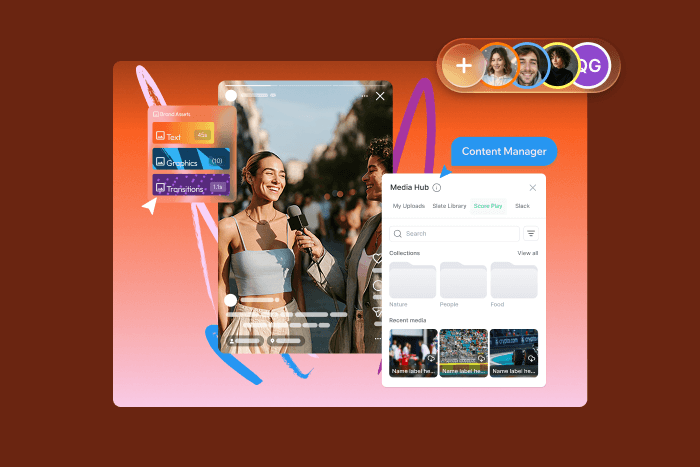
One structural mistake we see constantly: treating content creation as a solo act. A single "content creator" can't shoot, edit, write copy, design thumbnails, and format for six platforms. Teams that centralize their creative production workflow, using tools like Slate to coordinate feedback and approvals in one place, tend to ship two to three times more content without burning people out. The bottleneck is rarely the creating. It's the coordinating.
Community Management and Customer Advocacy
Community managers are the frontline. They respond to comments, manage DMs, handle crises before they escalate, and surface audience insights that no analytics dashboard can capture. This role often gets undervalued because it doesn't produce visible "content," but it's the reason some brands have fiercely loyal audiences and others have comment sections full of unanswered complaints.
Smart teams are also carving out a distinct Customer Advocacy role, someone who bridges social and customer support. They escalate product issues, loop in relevant internal teams, and turn negative interactions into recovery moments. If your community manager is also your crisis comms person and your customer support rep, you've got a structural problem, not a staffing one.
Common Organizational Models for Social Teams
There's no single "correct" way to organize a social team. But most structures fall into one of three models, each with distinct tradeoffs.
The Centralized Model for Brand Consistency
In a centralized model, one core team handles all social media activity across the entire organization. Every post, every response, every campaign runs through the same group. This is the default for most mid-sized companies, and for good reason: it keeps brand voice consistent and prevents the nightmare of three departments posting contradictory messages on the same day.
The downside? Speed. When every request funnels through one team, you create a chokepoint. Product launches, regional campaigns, and time-sensitive responses all compete for the same limited bandwidth.
The Distributed Model for Large Enterprises
Large enterprises with multiple brands, regions, or business units often distribute social responsibilities across those divisions. Each unit has its own social team operating semi-independently. This gives individual teams the agility to respond quickly and tailor content to their specific audience.
The risk is fragmentation. Without strong governance, you end up with wildly inconsistent brand experiences. One division's TikTok presence looks polished while another feels like it was made in 2019. Distributed models require shared brand guidelines, regular cross-team syncs, and a central governance body that sets guardrails without micromanaging.
The Holistic Hub-and-Spoke Approach
The hub-and-spoke model tries to capture the best of both worlds. A central "hub" team owns strategy, brand guidelines, and shared resources. "Spoke" teams embedded in business units or regions handle execution tailored to their audience. The hub provides the playbook. The spokes run the plays.
This is the model most enterprise brands are gravitating toward in 2026, and it works well when the hub team actually has authority. If the hub is advisory-only and spokes can ignore its guidance, you're back to the distributed model's fragmentation problem with extra overhead.
Scaling Your Structure Based on Company Size
The right team structure isn't static. It should evolve as your company grows, and the transitions between stages are where most teams stumble.
Lean Startup Frameworks
If you're a team of one to three people, forget org charts. You need a prioritization framework. One common approach: designate one person as the "strategist-creator" who plans and produces content, and one as the "community-analyst" who handles engagement and tracks performance. If you're truly solo, batch your work by function: strategy Mondays, production Tuesday through Thursday, community and analytics Friday.
The key at this stage is ruthless platform selection. You can't be everywhere. Pick two platforms where your audience actually lives and go deep. A startup trying to maintain presence on six platforms with two people will produce mediocre content on all of them.
Mid-Market Expansion Strategies
The transition from three people to eight or ten is the most dangerous phase. This is where informal processes break down. The "just Slack me for approval" workflow that worked with three people becomes a mess at eight. You need defined roles, documented workflows, and a content operations layer.
This is also the stage where a tool like Slate starts paying for itself, not because you need fancy features, but because you need a single place where content moves from draft to published without living in five different apps and three email threads. Mid-market teams that invest in workflow infrastructure early avoid the painful "everything is on fire" phase that hits when volume doubles but processes don't.
The Impact of Data and Social Listening Roles
Data roles on social teams have evolved beyond someone pulling monthly reports. Dedicated social analysts now run real-time listening programs, track competitive activity, and feed insights directly into content strategy. The best teams treat their analyst as a peer to the creative director, not a support function.
Social listening, specifically, has become a content engine. Analysts surface trending conversations, audience pain points, and cultural moments that creators can respond to within hours. Teams that separate listening from reporting, treating them as two distinct functions, tend to produce more relevant, timely content. The analyst who's buried in building a monthly deck isn't the same person who should be flagging a trending conversation at 2 PM on a Tuesday.
One pattern worth noting: some brands now embed a data person directly within the creative team rather than housing analytics in a separate department. This eliminates the lag between insight and action. When your analyst sits next to your video producer, the feedback loop shrinks from days to minutes.
Integrating In-House Teams with External Agencies
Most brands above a certain size work with at least one external agency. The question isn't whether to use agencies. It's how to structure the relationship so it doesn't create more friction than it solves.
Defining Ownership and Deliverables
The most common failure point in agency relationships is ambiguous ownership. If both your in-house team and your agency think the other is responsible for responding to comments on a paid campaign, nobody does it. Define ownership at the deliverable level, not the project level. Who writes the brief? Who produces the asset? Who approves? Who publishes? Who monitors performance?
A simple RACI matrix for each campaign type prevents 80% of the confusion. It's not glamorous work, but it's the difference between a smooth partnership and a blame cycle.
Maintaining Real-Time Communication Channels
Agencies and in-house teams often default to weekly status meetings and email updates. That cadence is too slow for social media. You need a shared workspace where both teams can see content status, leave feedback, and flag issues without scheduling a call.
Shared Slack channels help, but they're not enough on their own because context gets lost in chat. Centralizing the actual content workflow, drafts, feedback, approvals, and publishing, in a shared platform keeps everyone aligned without doubling the number of meetings. The goal is reducing the communication tax, not adding another layer of it.
Future-Proofing Your Social Media Hierarchy
The brands that will thrive over the next few years aren't the ones with the biggest teams. They're the ones with the most adaptable structures. That means building teams around functions and workflows rather than platforms. Platforms rise and fall. The ability to produce great content, engage an audience, and measure what matters doesn't expire.
Three structural bets worth making right now: First, invest in a content operations role. Someone who owns the workflow itself, not just the content, will become the most valuable person on your team as volume increases. Second, break down the wall between organic and paid social. Teams that plan these separately are leaving performance on the table. Third, treat your approval process as a product, not an afterthought. Every unnecessary approval step is a day of latency between idea stage and going live.
The way you organize your social media team matters more than most leaders realize. Structure shapes speed, and speed shapes relevance. Get the architecture right, and good people will do great work. Get it wrong, and even talented teams will spend half their time fighting the system instead of creating for the audience.